

Small business owners across the United Kingdom understand how every expense must prove its worth, especially when marketing budgets are tight. Choosing the right custom stamp is not just about finding the lowest price, but about securing a tool that reliably creates value and boosts your brand’s presence. By focusing on cost efficiency in custom stamps, you empower your business to cut waste, enhance recognition, and stretch every pound further in both branding and daily operations.
Table of Contents
- Understanding Cost Efficiency In Custom Stamps
- Types Of Custom Stamps For UK Businesses
- How Custom Stamps Enhance Branding And Savings
- Comparing Stamps To Other Branding Solutions
- Essential Tips For Maximising Stamp Value
Key Takeaways
| Point | Details |
|---|---|
| Cost Efficiency | Custom stamps provide a medium for marketing that maximises value while lowering operational costs across various business functions. |
| Branding Impact | Consistent use of branded stamps enhances professional image and reduces additional marketing expenses, promoting brand recognition. |
| Standardisation Benefits | Unified stamp designs across departments simplify training and maintain branding consistency, streamlining procurement processes. |
| Quality Matters | Investing in quality stamps will yield better long-term savings by reducing the frequency of replacements and ensuring consistent impressions. |
Understanding Cost Efficiency in Custom Stamps
Cost efficiency with custom stamps means getting the maximum value from every pound you spend. It’s not simply about finding the cheapest option—it’s about identifying which stamp solutions deliver the best return on your investment across multiple uses. For UK SMEs, this distinction matters considerably because your marketing budgets are typically tighter than larger corporations, and every business expense needs to justify itself.
When you invest in custom stamps, you’re acquiring a tool that works across numerous business functions. A single branded stamp replaces multiple generic alternatives, reducing the need to purchase standard office supplies. You use it for package verification, document authentication, promotional packaging, and internal filing. Reducing administrative burden and costs has been identified as a critical factor for enhancing trade efficiency in small businesses, and custom stamps exemplify this principle by consolidating multiple functions into a single, repeatable solution.
Measuring cost efficiency requires looking beyond the initial purchase price. Calculate the cost per use by dividing the stamp’s price by the estimated number of times you’ll apply it throughout its lifespan. A well made custom stamp used hundreds of times over two years costs far less per application than a cheaper stamp that deteriorates after three months. This is where quality genuinely intersects with economy.
Branding consistency also contributes to cost efficiency that many SMEs overlook. When customers receive consistently branded packages and documents, your professional image strengthens without additional marketing spending. This reduces the need for supplementary promotional efforts because your stamps do continuous branding work. Research on SME productivity and cost cutting measures demonstrates that targeted efficiency improvements directly improve competitiveness, and strategic branding investments like custom stamps fall squarely into this category.
The real efficiency gains emerge when you standardise your stamp usage across your business. Instead of different departments ordering their own solutions piecemeal, purchasing one well designed custom stamp ensures consistency whilst reducing ordering costs through consolidated procurement. Your team knows exactly which stamp to use for which purpose, eliminating confusion and duplicate purchasing decisions.
Pro tip: Calculate your cost per use by tracking how many times you’ll need your stamp monthly—if you use it more than 10 times weekly, a higher quality custom stamp becomes cost effective within 2-3 months of regular business operations.
Types of Custom Stamps for UK Businesses
Custom stamps come in several distinct varieties, each designed for specific business functions. Understanding which type suits your needs directly impacts how effectively you’ll use them and how much value you extract from your investment. Different stamps serve different purposes, from compliance and verification to branding and promotional applications.
Rubber stamps remain the most versatile option for UK SMEs. These stamps use flexible rubber plates mounted on wooden or plastic handles, allowing you to apply consistent impressions across documents, packages, and promotional materials. The rubber surface compresses slightly with pressure, ensuring even ink distribution and crisp, readable marks every time. Rubber stamps for branding and official use cover everything from basic date stamps to fully customised logos with your business name and contact details.
Date stamps and numbering stamps serve specific operational functions. Date stamps automatically record when documents were processed, received, or shipped, creating an audit trail without manual writing. Numbering stamps sequentially mark items, essential for tracking inventory or managing document workflows. These stamps reduce processing time considerably because your team applies them in seconds rather than handwriting dates repeatedly.
Compliance and verification stamps address legal requirements. Duty stamps and VAT compliance stamps are required for certain UK business transactions and customs procedures, particularly for imports and regulated products. Postage stamps remain necessary for traditional mail, though your custom branding opportunities here depend on your specific postal needs.
Promotional and branding stamps create lasting customer impressions. These include custom logo stamps for packaging, thank you stamps for invoices, and promotional stamps for event materials. They’re cost effective marketing tools because they deliver your branding repeatedly without additional spending once created. Many UK SMEs use these stamps on package seals, letterheads, and promotional merchandise.
Self-inking stamps offer convenience by automatically re-inking themselves after each use, eliminating the need for separate ink pads. Traditional pre-inked stamps give you more control over ink colour and intensity. Choose self-inking for high volume work, traditional stamps when you need precision or colour variation.
Pro tip: Match your stamp type to your use frequency: high volume operations (over 50 impressions weekly) benefit from self-inking stamps, whilst occasional use works well with traditional rubber stamps and manual ink pads.
The following table summarises key types of custom stamps and their primary business applications:
| Stamp Type | Main Use Case | Best For |
|---|---|---|
| Rubber Stamp | General office tasks | Flexible, daily marking |
| Self-Inking Stamp | High volume routines | Fast, repeated use |
| Date/Numbering Stamp | Tracking & audit trails | Process validation |
| Compliance/Verification | Legal requirements | Regulated documentation |
| Promotional/Branding | Customer engagement | Visual brand consistency |
How Custom Stamps Enhance Branding and Savings
Custom stamps function as dual-purpose business tools that simultaneously strengthen your brand identity whilst reducing operational costs. When you apply a branded stamp consistently across packages, documents, and marketing materials, you create a visual reinforcement that builds customer recognition without additional spending. This approach delivers branding benefits that would otherwise require separate investment in printed materials or promotional products.

Branding consistency matters because customers begin associating your stamp impression with your business. Every parcel that leaves your facility carries your mark, turning routine packaging into a branding opportunity. This passive marketing works continuously, creating touchpoints with customers who handle your packages long after purchase. The psychological impact of repeated brand exposure strengthens memory and loyalty, making your business feel established and professional.
The cost savings emerge from consolidating multiple business functions into single tools. Instead of purchasing custom printed packaging, branded labels, and promotional materials separately, one well-designed stamp handles all three functions across different applications. Your team applies the same stamp to invoices, shipments, and documents, eliminating the need for multiple solutions. This consolidation reduces both your ordering complexity and inventory costs.
Custom stamps also minimise waste compared to alternatives. Printed materials become obsolete when your branding changes, forcing replacement purchases and discarding unused stock. Stamps adapt easily because you simply use different ink colours or swap the stamp itself without wasting existing materials. Cost savings through efficient branding distribution demonstrates how consistent brand presentation improves business value whilst reducing the expenses associated with fragmented promotional efforts.
VAT efficiency adds another savings layer. Personalised stamps and philatelic supplies benefit from specific VAT exemptions in certain circumstances, meaning your stamp investment may not incur the standard 20% VAT that applies to other promotional materials. Understanding these exemptions helps you maximise your budget’s purchasing power.
When customers receive consistently branded materials, they perceive higher professionalism and quality. This perception justifies premium pricing for your products and services, improving profit margins without increasing costs. Your branded stamp becomes a subtle indicator that you invest in your business presentation, encouraging customers to trust your professionalism.
Pro tip: Track where your stamps get used most frequently and prioritise those applications for branded custom stamps, then use standard stamps for lower-visibility tasks to maximise branding impact whilst controlling costs.
Comparing Stamps to Other Branding Solutions
Custom stamps compete against numerous branding alternatives, each with distinct cost structures and effectiveness profiles. Understanding how stamps compare helps you make informed decisions about where to allocate your limited marketing budget. Different solutions suit different business needs, and stamps often emerge as the most cost-efficient option for UK SMEs facing tight budgets.
Printed packaging represents one common alternative. Custom printed boxes, labels, or mailers deliver professional branding but require minimum order quantities typically between 500 and 5000 units. Initial costs range from £200 to over £1000 depending on complexity. Once printed, you cannot modify designs without ordering new batches, creating waste when branding changes. Custom stamps, by contrast, require no minimum order and cost £10 to £50 for a quality impression tool that remains useful indefinitely.
Digital branding solutions like email signatures and social media graphics reach customers online but lack physical presence. Customers never hold or touch digital branding, reducing its psychological impact. Stamps create tangible, tactile interactions that digital channels cannot replicate. Every package your customer handles reinforces your brand through physical contact, creating memory associations that digital alone cannot achieve.
Trade mark registration provides legal protection for your brand identity but serves a different purpose than promotional branding. Trade mark registration processes protect your intellectual property from competitors copying your name or logo, typically costing £200 upwards. Stamps work alongside trade marks rather than replacing them. Stamps apply your protected brand visibly whilst trade marks defend it legally.
Promotional merchandise like branded pens or USB drives costs £1 to £5 per item, we supply these through our sister website YouPromotions. Supplying meaningful quantities requires significant budget. Stamps cost less per impression when used across hundreds or thousands of applications. Cost-effective branding approaches for SMEs emphasise balancing expense with reach, where stamps deliver exceptional value because impressions continue indefinitely without repurchasing.
Comparison highlights stamps’ unique advantage. They cost less upfront than printed materials, adapt easily when branding changes, create physical brand touchpoints, and deliver unlimited impressions. Most SMEs benefit from combining stamps with other solutions. Use stamps for daily operations and customer touchpoints, trade mark registration for legal protection, and selective printed materials for premium presentations.
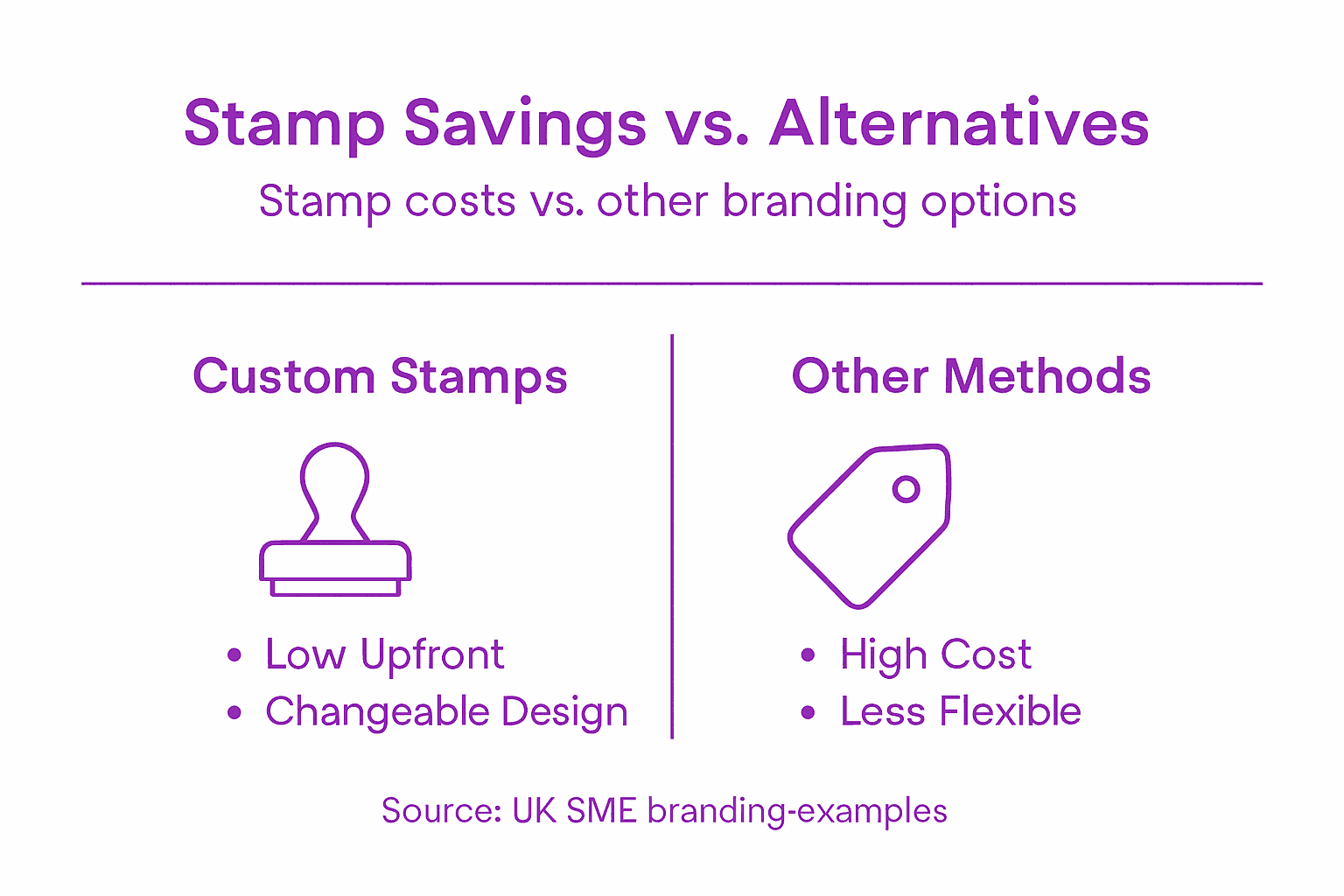
Here is a comparison of common branding solutions for SMEs, highlighting unique advantages of custom stamps:
| Branding Solution | Upfront Cost | Adaptability to Changes | Physical Brand Presence |
|---|---|---|---|
| Custom Stamps | £10–£50 | Easy: update ink/stamp | Strong: every package/item |
| Printed Packaging | £200+ | Difficult: reorder batch | High, but inflexible |
| Digital Graphics | Minimal | Easy: update online | None |
| Promotional Items | £1–£5/item | Moderate: re-order items | Occasional |
| Trade Mark Registration | £200+ | Not applicable | Legal, not physical |
Pro tip: Start with a basic custom stamp covering your core need (invoices, packages, or documents) and measure cost per impression after three months, then decide whether to expand your stamp collection or invest in complementary branding solutions.
Essential Tips for Maximising Stamp Value
Maximising stamp value requires deliberate strategies that extend beyond simply purchasing a quality tool. Your stamp represents an ongoing investment, and how you use it determines whether you recoup that investment quickly or squander its potential. Small decisions about design, placement, and standardisation compound over time to create substantial savings.
Standardise your stamp design across departments and purposes. When finance, shipping, and administration all use identical branded stamps, you consolidate purchasing power and reduce the complexity of training staff on which stamp to use where. Standardisation also strengthens brand consistency because customers encounter the same visual mark regardless of which team member handles their order. This unified approach costs less than maintaining multiple stamp designs whilst delivering stronger branding impact.
Choose high quality materials from the outset. Cheaper stamps deteriorate within weeks or months, forcing replacement purchases that negate initial savings. Quality rubber stamps maintain impression clarity through thousands of applications, spreading your initial investment across far more uses. The cost difference between a basic stamp and a quality version typically amounts to just £5 to £10, yet the quality version lasts three to four times longer.
Identify your highest volume applications and prioritise those for branded stamps. If you process 200 invoices monthly but ship only 20 parcels, invest in an invoice stamp rather than a shipping stamp. This strategic focus ensures your stamp delivers maximum value in your highest impact areas. Lower volume applications can use standard stamps, balancing branding visibility with budget efficiency.
Store stamps properly to extend their lifespan. Keep rubber surfaces clean and protected from direct sunlight, which deteriorates rubber over time. Replace ink pads before they dry completely rather than trying to squeeze final drops from exhausted pads. Quality stamping materials and proper maintenance represent practical procurement advice that directly maximises the value of your stamp investment through extended durability.
Track where your stamps deliver the most value through customer feedback and engagement metrics. Notice which stamped materials customers comment on or display prominently. Use this insight to refine your stamp strategy over time. Effective use of branded materials in business communication helps you understand which applications generate genuine business benefits worth your ongoing investment.
Pro tip: Document your monthly stamp usage by application type for three months to identify which areas generate the most impressions, then allocate future stamp investments toward your highest volume functions for maximum cost efficiency.
Unlock Cost Efficiency with Custom Stamps from StampDesign4U
For UK SMEs striving to enhance cost efficiency and strengthen their brand, custom stamps offer a smart, long-lasting solution. Whether you need reliable rubber stamps for daily office tasks or quality self-inking options for high-volume use, StampDesign4U specialises in tailored stamp designs that fit your business needs. Avoid overspending on printed materials and maximise your branding impact while reducing operational costs.
Explore our extensive range of custom stamps designed to save you time and money. Start with a personalised stamp that supports your busiest functions and experience the savings firsthand. Visit StampDesign4U today to create your ideal stamp and see how quickly smart branding can boost your business. Discover more about our product options and how they can transform your efficiency here. Take control of your brand identity and costs now.
Frequently Asked Questions
What are the benefits of using custom stamps for my business?
Custom stamps provide cost efficiency by consolidating multiple functions into a single tool, such as branding, document verification, and internal filing, ultimately reducing the need for various office supplies and decreasing overall expenditure.
How can I calculate the cost per use of a custom stamp?
To calculate the cost per use, divide the initial price of the stamp by the estimated number of times it will be used throughout its lifespan. This helps determine the true value of your investment over time.
What types of custom stamps are available for business applications?
There are several types of custom stamps, including rubber stamps for general use, self-inking stamps for high-volume tasks, date and numbering stamps for tracking, compliance stamps for legal documentation, and promotional stamps for branding purposes.
How can I maximise the value of my custom stamps?
To maximise value, standardise the stamp design across your business, choose high-quality materials, identify high-volume applications for branded stamps, and properly maintain your stamps to extend their lifespan.
Recommended
- Complete Guide to Why Choose Custom Stamps – Stamp Design 4U
- Custom Stamps: Everything You Need to Know – Stamp Design 4U
- Why Design Your Own Custom Stamp: A Complete Guide – Stamp Design 4U
- Custom vs Pre-Made Stamps – What’s Best for You? – Stamp Design 4U
- A Guide to the Phone Case UV Printer – Bettermockups